Master of Science in Global & International Education Online Master’s & Bachelor’s Degree Programs – Online MBA Degrees at Drexel.com
Drexel Online.  A Better U.

Master of Science in Global & International Education

DEADLINE ALERT!
Applications and all supplemental materials for the next term must be submitted by:

March 05, 2010
Sidebar Divider
ONLINE OPEN HOUSE!
Drexel University Online is holding an Online Open House for the MS in Global and International Education on Dec. 1st. Click here to register... 

Sidebar Divider

What's New
Dr. Kristen Betts and Dr. Rebecca Clothey, auxiliary assistant professors at the School of Education, and Lora Furman, graduate co-op, operations and program assessment for the Steinbright Career Development Center, presented "Beam Me Up Scotty: Online Graduate Co-op and Professional Development through Simulation" at the 2008 World Association of Cooperative Education Asia Pacific Conference. Dr. Clothey joined the presentation through Second Life and Horizon Wimba.


TUITION REDUCTION
Does your organization provide tuition benefits through Drexel University Online?

Sidebar Divider


Print | Email To A Friend | Share Share

Global & International Education Frequently Asked Questions

Program Overview: What is the significance of a Master of Science (MS) degree in Global & International Education?

Applicants: Who should apply to the Master of Science in Global & International Education degree program?

Job Placement: What types of careers are available in Global & International Education?

Program Overview: Why should a prospective student select Drexel University to pursue a MS degree in Global & International Education?

Cetification Specialty: What additional content courses will I need for certification in a certain subject area?


What is the significance of a Master of Science (MS) degree in Global & International Education?

The M.S. in Global and International Education provides an intensive opportunity for the study of globalization in higher education, comparative education, and international education. An interdisciplinary approach is used in the study of education’s role in economic, political, and socio-cultural development; international educational exchange; and the internationalization of education. The program seeks to build knowledge about education as one of several interacting sectors of society and analyzes the role of education systems within and among different countries of the world.

Focusing on the world as developing entities and regions, topics covered will include: the origins of thinking regarding economic, political, and social development; theories and contemporary views on the concept of development; formal and non-formal education and national development; women and education in development; education in development policy; development cooperation and education; the role of the state and market forces in education; and global and regional disparities and literacy. Additionally, there is a required internship/co-op requirement that culminates in the publication of an electronic portfolio.

Global and International Education does not use the lens of traditional K-12 public schooling in America for analysis. Rather, the M.S. in Global and International Education is designed to investigate a variety of non-formal modes of education such as: ecological education, after school programs, adult learning, home schooling, rural versus urban education, and community based educational efforts.

Back to top


Who should apply to the Master of Science in Global & International Education degree program?

  • Recent graduates from undergraduate programs who want to pursue careers in higher education, English as a Second Language (ESL) programs, education abroad, law firms, international education associations, accreditation agencies, local community international outreach centers, U.S. government, international development or human service agencies, or non-governmental agencies.
  • Individuals currently working in higher education or other areas with an international focus who want to advance and accelerate their careers;
  • Individuals who are interested in transitioning from their current area of employment (i.e., corporate sector, military, healthcare, research, etc.) to the international educational arena; and
  • International students and administrators seeking a master’s degree in global and international education, which provides them with an in-depth knowledge regarding use of cross-cultural perspectives in training employees and researching in public and private (non-profit and for-profit) institutions.

Back to top


What types of careers are available in Global & International Education?

The M.S. in Global and International Education program has academic relationships with numerous national and international associations. Students are encouraged to join associations as student members, attend conferences, present research, submit research for publication, and network. The program also works closely with administrators at higher education institutions, associations, NGOs, community-based programs, and recruitment firms to assist students with job placement upon graduation.

Global & International Education goes beyond the traditional “bricks and mortar” of a college campus; therefore, this degree provides students with the skills and knowledge to pursue careers within and outside of academia. Depending upon a student’s concentration(s), there are numerous career opportunities:

  • International Organizations (e.g., World Bank, Inter- Monetary Fund-IMF; Inter-American Development Bank-IADB; United States Agency for International Development-USAID; United Nations Educational, Scientific & Cultural Organization-UNESCO; International Association of Universities-Affiliate of UNESCO; Institute of International Education-IIE; Council for International Educational Exchange-CIEE; Association of International Education Administrators-AIEA; etc.)
  • Non-profit and for-profit Organizations/Corporations (e.g., museums, informal education organizations, foreign language businesses, etc.)
  • Government Agencies - Educational and training divisions/programs (e.g. U.S. Department of Education; State Departments of Education; National Center for Education Statistics-NCES; Federal TRIO Programs/Council for Opportunity in Education-COE; etc.)
  • Politics - Relating to Global & International Education (e.g. political consultant, lobbyist, advisor, etc.)

Back to top


Why should a prospective student select Drexel University to pursue a MS degree in Global & International Education?

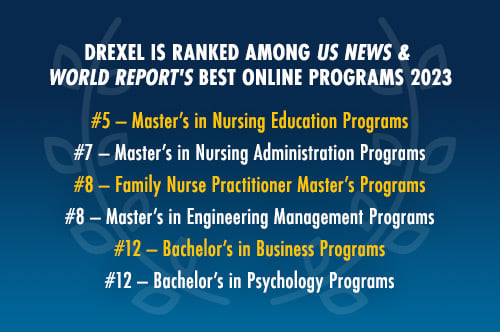
As one of the most innovative universities in the United States today, Drexel University offers degree programs that provide students with skills and experiential learning opportunities through relevant assignments/projects and co-operative education. This is critical since career placement and advancement is often contingent upon skills, knowledge, experience, and educational attainment. Moreover, Drexel is among the top 50 private, non-profit, national doctoral/research universities in the U.S., and is ranked by U.S.News & World Report as one of America's Best Colleges for 2007. U.S.News & World Report also ranked The Drexel University School of Education among America’s Best Graduate Schools in the 2007 edition of its annual rankings. Drexel consists of 11 colleges and schools offering 161 degree programs to approximately 16,000 students. It has over 90,000 alumni and 1,000 full-time faculty members. Founded by financier and philanthropist Anthony J. Drexel in 1891, Drexel continues to be a leader in the integration of technology into academics.

The “value added” and the “market advantage” of a Drexel M.S. program derives from the mission and from the development of innovative methods of thinking, learning, and acting in our graduates. Individual course content, areas of concentration, the internship/co-op experience, and use of technology within the traditional classroom setting and for on-line course delivery make this program truly unique and competitive.

Here's what one of our students has to say:

"This course [EDGI 508] as well as this program has broadened my thinking. I have learned to look more closely at the people within societies and have learned much concerning my understanding of essentialism, for instance. I can now not only state how I feel about something when speaking about different cultures, but I am able to provide more meaning and thought to my answers with interesting and in depth examples. In turn, this gives rich meaning in communication with others. I have been asked at work “what am I doing this quarter?” and with a lengthy answer, I have told them about Tibet, about Xinjiang, I have spoken more comfortably, in more detail about language, culture, and have been able to identify a way to apply this in my work and research. Besides speaking comfortably, I have learned so much about language and its effect on Education and Society as a whole. This program has been one of the best decisions I have ever made. I also realize with what I have learned thus far, there is more to learn…there is a big world out there. With this understanding, I always make it clear…I have a lot more to learn and there may be more." - Andrea R., Raleigh, NC

Back to top


What additional content courses will I need for certification in a certain subject area?

Once you have applied to the program, an advisor will review your transcripts to determine if any undergraduate coursework is missing, and which additional content courses you will be required to take.

Back to top