icon above to turn off Compatibility Mode, which is only for viewing older websites.
RN to BSN Online Nursing Program
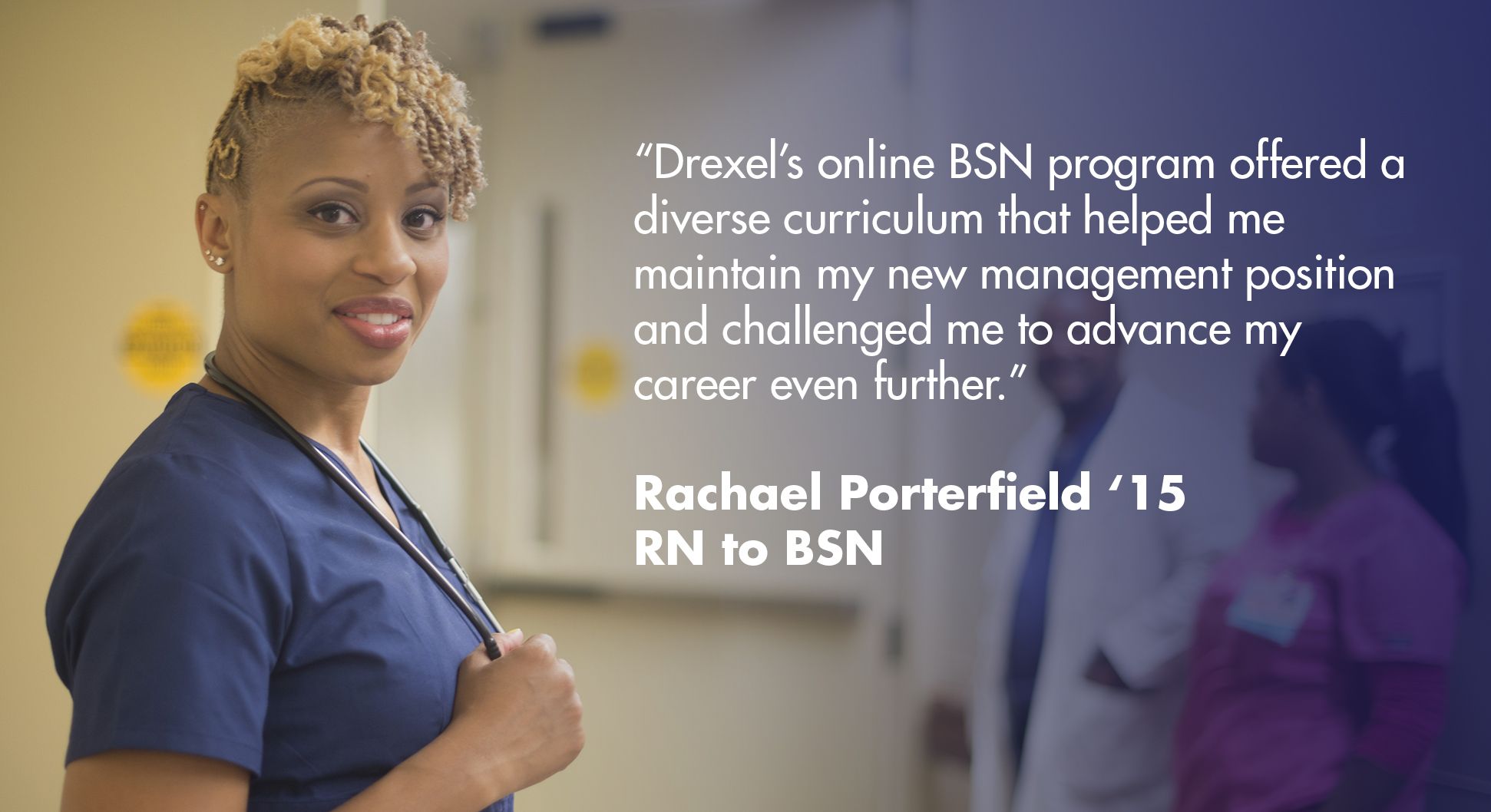
You can always spot a Drexel Nurse
The Drexel University Bachelor of Science in Nursing accredited online program is a different sort of online RN to BSN program. At Drexel, we know you’re looking for a career-focused RN-to-BSN program that empowers you to challenge tradition by focusing on evidence-based and experiential learning that you can put to work immediately. The best part is that employers already know what makes a Drexel nurse stand out. Grounded in easy-to-use, technology-enhanced coursework designed to move beyond lectures and note taking, the curriculum focuses on the action-based, practical, in-depth clinical skills you need every day to improve patient outcomes.
Obtain your BSN in as little as 12-months
Drexel understands that your time is valuable. To help you achieve your professional goals on your timeline, Drexel will allow you to transfer up to 135 of the required 180 quarter credits to graduate. In addition to the generous transfer credit policy, Drexel has adopted an accelerated format option to allow you to complete the final 9 nursing courses in just 12-months…that is, if that plan works for you. Since flexibility matters to you, it is very important to us, as well. That is why we provide you with the choice to follow the accelerated plan of study or take the time you need to complete the program at your pace. Our 3-year tuition lock will provide you with piece of mind that you are able to set your pace and maintain the same tuition rate for three years. All of these options give you the path to earn your degree more quickly, while also concentrating on the courses that matter most to you and your career.
Archived Webinar
What is an RN to BSN Degree?
The RN-BSN degree program is designed for nurses that have their Registered Nurse (RN) licensure and would like to continue their educational journey by earning a bachelor of science in nursing (BSN). In addition to your RN licensure, a Bachelor of Science in Nursing (BSN) degree prepares you for a nursing career. A 2010 Institute of Medicine (IOM) study predicts that nurses with a baccalaureate degree will increase from 50 percent to 80 percent by 2020. In the highly competitive field of nursing, a Drexel University RN-to-BSN degree can help give you an edge with minimal disruption to your hectic work schedule. By earning this bachelor’s degree online, you're able to remain employed while learning valuable skills that will result in greater career opportunities over time.
What Kind of Jobs can you get with a BSN?
A bachelor of science in nursing will prepare you for a wide variety of job opportunities, including:
- Registered Nurse
- Operating Room/Perioperative Nurse
- Critical Care/ICU Nurse
- Emergency Room Nurse
- Labor and Delivery Nurse
- Medical/Surgical Nurse
- Charge Nurse
- Case Manager
- Home Health Nurse
- Hospice Nurse
- Oncology Nurse
- And many more...
According to the Bureau of Labor Statistics, registered nurses can expect a 15% increase in employment opportunities by 2026. This is considered to be much faster than the national average for all occupations. In today’s healthcare market, registered nurses with their BSN will have an easier time finding a job than those without a BSN:
- 43.7% of hospitals and other healthcare settings are requiring new hires to have a BSN
- Rate of job offers for new nursing graduates four to six months after program completion:
- 89% for entry-level BSN graduates
- 90% for entry-level MSN graduates
American Association of Colleges of Nursing
Learn more about the best cities and states in the United States to work as a nurse.
RN to BSN Salary
Registered nurses (RNs) can expect favorable starting salaries. This is primarily due to the anticipated nursing shortage the industry is expecting to worsen over the next decade, which is being impacted by the number of baby boomer generation nurses that are beginning to retire. According to the Bureau of Labor Statistics, the national median nurse starting salary in 2016 was $68,450. In addition, overall employment in the field expected to rise 15% within the next decade. Nurse Practitioners have the highest salary of all employees in the field ($95,350-95,820). The current RN starting salary is $15,000 more than that of an LPN.
- Nurse Median Annual Pay in 2016 - $ 68,450
- Increase in Jobs Through 2024 - $ 15%
Bureau of Labor Statistics, U.S. Department of Labor
Learn more about current and projected salaries and trends in the nursing industry overall.
What makes Drexel’s online Bachelor of Science in Nursing program stand out?
- It’s fully accredited by the Commission on Collegiate Nursing Education (CCNE)
- Employers know graduates of Drexel’s online BSN program perform better in their profession and assume roles that demand critical-thinking, decision-making, communication, and leadership skills
- Outstanding support services are provided, including 24/7 tech support, online access to Drexel University’s award-winning W.W. Hagerty Library, Drexel’s Writing Center, and much more
- There are no on-campus requirements
How will Drexel’s RN-BSN curriculum help my nursing career?
- Classes are taught by experienced and board-certified faculty from Drexel’s acclaimed College of Nursing and Health Professions
- Drexel’s collaborative learning platform lets you engage with your classmates over message boards and video chats, sharing your knowledge and helping each other incorporate it into your daily practice
- Classes utilize interactive software like Shadow Health and Practice, allowing you to examine a virtual patient and upload self-produced videos to demonstrate the skills you are mastering in class
- Robust practice experiences are woven through each aspect of the curriculum using both traditional and innovative learning technologies, such as simulation labs, problem-based web learning, direct patient interaction, and community outreach
- The action-based learning and in-depth clinical and leadership skills you acquire can be used immediately to improve patient outcomes and lead nursing into the future
How fast and affordable is Drexel’s online RN-BSN program?
- You can transfer up to 135 of the required 180 quarter credits, giving you the option to earn your degree more quickly, while also concentrating on the courses that matter most to you and your career
- Special tuition plans for ANA members, employees of health system partners and community colleges
- Three-year tuition lock is available for those who complete the RN to BSN program within 3 years. No hassle, no fuss, no rising tuition. Enroll in Drexel’s top-ranked online RN to BSN program and enjoy the same tuition each term if you complete the program in three years.
Related Programs
RNs who hold bachelor’s degrees in another field of study can prepare for an advanced degree through either the RN to MSN or RN-BSN-MSN online programs:
Questions? We're here to help!
CNHP Recruitment Team
AskCNHP@drexel.edu
267.359.5555
State restrictions may apply to some programs.
The RN to BSN program at Drexel University is accredited by the Commission on Collegiate Nursing Education.
Curriculum
This program is organized into four 10-week quarters per year (as opposed to the traditional two semester system) which means you can take more courses in a shorter time period. One semester credit is equivalent to 1.5 quarter credits.
You can transfer up to 135 quarter credits (equivalent to 90 semester credits) from any accredited institution of higher learning as long as the grade is a C or better. Most credits will fulfill liberal arts or general classes.
| Tier 1 Courses | ||
| ENGL 101 or ENGL 111 |
Composition and Rhetoric I: Inquiry and Exploratory Research or English Composition I |
3.0 |
| ENGL 102 or ENGL 112 |
Composition and Rhetoric II: Advanced Research and Evidence-Based Writing or English Composition II |
3.0 |
| ENGL 103 or ENGL 113 |
Composition and Rhetoric III: Themes and Genres or English Composition III |
3.0 |
| Or transfer in 2 English courses (3 semester credits from a semester school) must include one semester of composition | ||
| Humanities Elective | 3.0 | |
| Intro to Sociology | 3.0 | |
| General Psychology | 3.0 | |
| Developmental Psychology | 3.0 | |
| Nursing Electives | 45.0 | |
| Anatomy & Physiology I & II (w/ Labs) | 10.0 | |
| Microbiology w/ Lab | 5.0 | |
| Science Elective | 3.0 | |
| Tier 2 Courses | ||
| Intro to Computer Science of Communication | 3.0 | |
| Statistics of the Health Sciences | 4.0 | |
| Health Care Economics, Macro or Micro | 4.0 | |
| Health Care Ethics I or Advanced Health Care Ethics | 3.0 | |
| Social Science Elective | 3.0 | |
| Science Electives | 6.0 | |
| Pharmacology or Advanced Physiology or Pathophysiology | 5.0 | |
| Open Electives | 23.0 | |
| Tier 3 Courses | ||
| NURS 325 | Critical Issues in Nursing | 4.5 |
| NURS 330 | Nursing Research: Methods and Critical Appraisal for Evidence-Based Practice | 4.5 |
| NURS 335 | Genetics and Genomics: Application to Nursing Practice | 4.5 |
| NURS 340 | Transformational Leadership | 4.5 |
| NURS 346 | Health Assessment | 6.0 |
| NURS 380 | Complex Systems of Care: Technology, Patient Safety, and Quality | 6.0 |
| NURS 407 | Issues in Aging and Longevity | 4.5 |
| NURS 460 | Population Health: Local and Global | 6.0 |
| NURS 465 | Senior Capstone in Nursing | 4.5 |
| Total Credits | 180.0 | |
Admissions Criteria
- High School diploma or equivalency
- Associates degree or diploma in Nursing
- College GPA of 2.0 or above
- Current, unrestricted United States RN licensure
- Your application will be reviewed prior to taking the NCLEX exam.
- If you're preparing to sit for the NCLEX, you're welcome to apply and start the program on a provisional basis. Once RN licensure is obtained, you may matriculate into the RN-BSN program.
- Official transcripts must show that 60 semester hours of the following college prerequisites were completed with a grade of C or better. It is expected that students have the majority of these requirements complete at the time of application, including at least one college-level English course.
- Nursing - 30 hours
- English (including one semester of composition) - 6 hours
- Humanities (studio courses not acceptable) - 3 hours
- Anatomy and Physiology - 8 hours
- Microbiology - 4 hours
- Sociology - 3 hours
- Growth and Development - 3 hours
- Psychology - 3 hours
- If you have an RN License from outside of the United States, you may need to submit additional materials.
Articulation Credits
- Students must be graduates of a nursing program that is both regionally accredited and accredited by either the Accreditation Commission for Education for Nursing (ACEN), or the National League for Nursing Commission on Nursing Education Accreditation (NLN CNEA). Students who meet criteria of the Pennsylvania Nursing Articulation Model will receive credit for 30 semester hours of nursing, which may be applied toward the program entrance requirements.
Tuition
The tuition rate for the academic year 2024-2025 is $549 per credit. (A 40% tuition savings off Drexel's regular tuition rate of $915 per credit)
The 40% tuition savings applies only to new students starting in the Fall 2024, Winter 2025, and Spring 2025 terms and cannot be combined with any other tuition benefits available through Drexel University.
- This program is eligible for Financial Aid.
- Special tuition rates available for Drexel University Alumni, Military members, and members of our Partner Organizations.
- These rates apply only to new online students and students being readmitted.
- All students must contact applyDUonline@drexel.edu within the first two weeks of the term to request tuition savings for which they qualify.
- Special rates cannot be combined. If you qualify for more than one special rate, you'll be given the one with the largest savings.
- When receiving special tuition plans with Drexel University Online, you may not combine them with other tuition benefits that may be available from Drexel University.
During the RN-BSN program, you will focus on the professional role of the public health/community nurse working collaboratively with aggregates, community partners, and health officials within the community as part of an interdisciplinary team in order to promote a healthier community. An introduction to conceptual frameworks that guide community-based, population-focused practice and research is included in both the classroom and the clinical portions of the course. You'll use skills in community assessment, program planning, and nursing interventions to help identified populations within community attain and maintain their optimum level of health. Selected measures for evaluating the outcomes of community health nursing programs are discussed as well as those that may be broader in scope.
The practice component involves a community assessment, a health promotion and disease prevention program, program project planning and implementation, as well as collaboration with others in the community. It is also expected that you'll have opportunities to look at community resources, talk with community partners and if possible experience community outreach.
Ideas for Experiential Learning
Community Nurse Roles
|
|
|
Agencies
|
Government Funded City public health departments |
Miscellaneous Roles Breastfeeding support groups |
|
Community Mental Health Community-based mental health centers |
Not-for-Profit Organizations & Outreach Groups American Cancer Association |
|
Hospital-Based Programs Clinics for low-income families |
Senior Citizen Support Adult day care services for special needs seniors Alzheimer programs |
|
Home Visiting Home hospice agencies |
Social Service Agencies Homeless shelters |
Academic Calendar
2023-2024 Academic Year
Term
Classes Begin
Classes End
Exams Begin
Exams End
Fall 2023
September 26, 2023
December 9, 2023
December 11, 2023
December 16, 2023
Winter 2024
January 8, 2024
March 16, 2024
March 18, 2024
March 23, 2024
Spring 2024
April 1, 2024
June 8, 2024
June 10, 2024
June 15, 2024
Summer 2024
June 24, 2024
August 31, 2024
September 3, 2024
September 7, 2024
Apply for admission to Drexel University
Use the Apply Now form to get started.
Previously enrolled at Drexel? Learn more about readmission.
Any problems? Find help or contact us.